
Do Hotels Need to Optimize Their Brand Portfolios?

How To Use This Brief
Decision briefs lay out the key evidence, strategic context, and paths forward behind a specific strategic choice. Skift's recommended path is option B (see section 5).
For
- Marketing
- Commercial
- Brand strategy
Included in Enterprise & Global Tier
Skift View
01 / 07
Hotels have spent the past decade cornering the market on supply — brands for every segment, loyalty programs for every traveler, options in every region. Now the dynamics are changing. AI is compressing the discovery funnel to a handful of recommendations. Travelers are struggling to distinguish the myriad of brands from one another. The supply problem is largely solved, but a new, demand-side problem is emerging. Namely, how to make brands stand out in AI-powered searches and bookings. Hoteliers must decide how to refine and market their brand portfolios to keep up with the modern traveler, delivering tangible benefits and not just large portfolios.
Key TAkeaways
02 / 07
01 Brand count does not equal brand power
Portfolio expansion has not consistently translated into stronger RevPAR or margin growth. Marketing teams should evaluate brands based on pricing power and incremental demand, not internal growth optics.
02 Differentiation is under strain
Travelers increasingly perceive brands within the same group as interchangeable. Each brand must articulate a clear, defensible value proposition or risk reinforcing the parent portfolio more than itself.
03 Loyalty scale without personalization is fragile
More brands expand choice, but they do not guarantee attachment. Competitive advantage now lies in relevance — tailored rewards, guided brand fit, and frictionless cross-brand experiences.
04 Soft and conversion growth require discipline
These brands are efficient economic vehicles, but without strong positioning and enforcement of standards, they dilute portfolio clarity. Growth must be matched with guardrails.
05 AI compresses visibility
In AI-led discovery environments, only a few brands surface. Clear positioning, strong reviews, and consistent brand signals matter more than portfolio coverage.
06 Complexity demands accountability
Brand proliferation adds marketing costs, operational strain, and signal risk. Each brand should justify its place in the portfolio with measurable performance contribution.
The Signal
03 / 07
Brand count across the six major U.S. hotel groups has doubled since 2014, while RevPAR growth has actually softened during the same period. The fastest-growing portfolio by brand count since 2019 delivered the weakest median RevPAR. This is an indication that scale is not synonymous with strength and that brand proliferation has decoupled from overall revenue performance.
AI tools limit search results to 2–3 options and are being rapidly adopted. Skift Research's data suggest that loyalty affiliation is less meaningful than in the past and AI may accelerate that shift; travelers may be willing to switch loyalty if they receive better personalization.
Key Evidence
04 / 07
Exhibit 1
Brand count growth does not equate to RevPAR growth
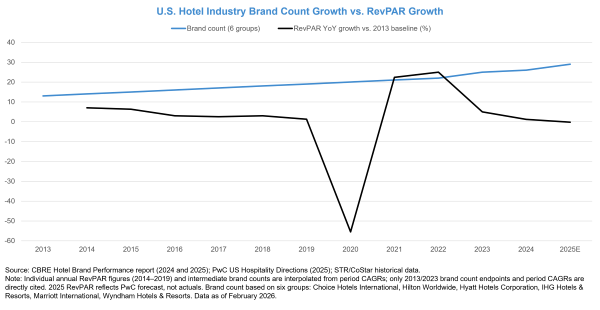
The six major U.S. hotel groups doubled their brand counts between 2014 and 2024, reaching an average of 24 brands, while loyalty membership grew at a CAGR of 15%. Yet since 2019, RevPAR growth has been modest at best. This suggests that more brands and broader portfolios do not necessarily translate into stronger pricing power at the property level.
Personalization and brand clarity are likely to play larger roles in driving hotel performance in future. AI could accelerate this change.
Exhibit 2
Soft brands have boomed, but may dilute strong branding
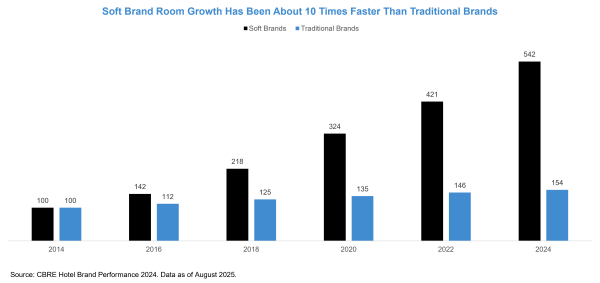
Adding soft brands allowed hotel groups to grow quickly without strict standards for experience or identity. The emphasis on individuality appealed to owners and developers. As a result, soft brands have expanded roughly 10 times faster than traditional hard brands. In many cases, soft brands and conversion brands have added rooms quickly and captured supply that might have gone to competitors.
This was powerful, but came with a trade-off: the blurring of traditional hard brand boundaries. Over time, this approach has created clusters of brands with overlapping positioning, especially in the upper-midscale and lifestyle segments. Consumer data from Skift Research reflect this gap: hard brands such as Hampton Inn, Marriott Hotels, and Holiday Inn are more consistently preferred over soft brands like Tapestry, Curio, and Autograph Collection — on average, the hard brands were preferred by a factor of 1.7x.
For marketers, this creates tension. High expectations from guests mean inconsistency is quickly punished. When properties fail to deliver on brand promises, even a single weak hotel can undermine years of brand investment.
Exhibit 3
Consumers are losing clarity on what brands actually stand for
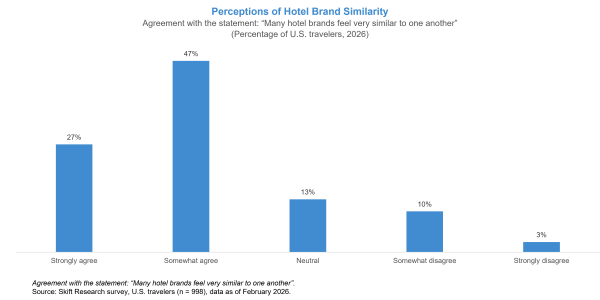
The most direct signal that hotel brand portfolios may have expanded beyond their ability to maintain differentiation comes from how travelers describe the hotel brand landscape today.
In Skift Research's survey, the majority of travelers agreed that many hotel brands feel at least somewhat similar to one another. When brands blur into the same mental category, marketing investment builds the category rather than the brand, reducing returns on brand spend over time.
Exhibit 4
Personalization, not portfolio scale, is the new loyalty battleground
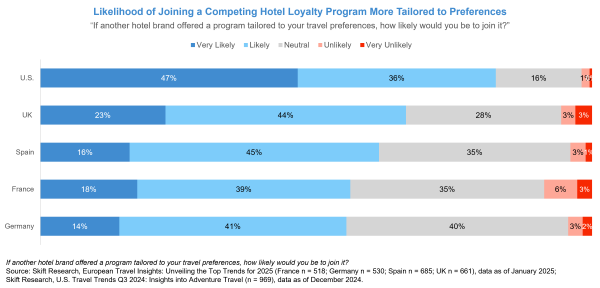
Across markets, many travelers say they would switch loyalty programs if a competitor offered more personalized rewards. That changes loyalty from a numbers game to a contest for relevance. Scale alone isn't protective. Large portfolios promise more earning and redemption options, but without personalization, breadth can quickly become complexity.
Loyalty retention is evolving and now requires precision in addition to network coverage. Programs must turn portfolio scale into individualized value, or risk losing members.
Exhibit 5
Supply built loyalty, but AI could shake that loose
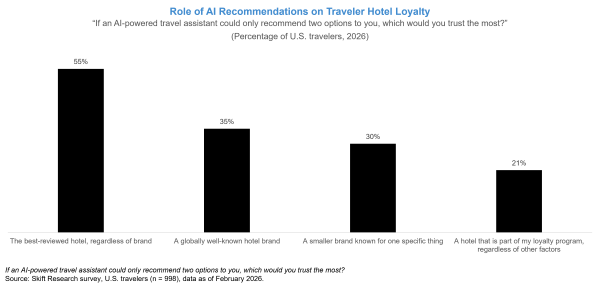
AI assistants don't return pages and pages of results, they come back with just two or three properties. When Skift Research asked travelers which hotel they would trust if AI gave them only two options, loyalty program membership ranked last. The top answer was simply the best-reviewed property, regardless of brand.
This suggests that, with AI, scale doesn't surface hotels — but reputation does.
This challenges the assumption that brand and loyalty scale guarantees visibility. In AI-led funnels, distinctiveness and strong reputation signals matter more than portfolio density.
Three PAths Forward
05 / 07
Option A
Rationalize: Consolidate the portfolio around fewer, stronger brands
Proactively audit the portfolio, retire or merge brands with overlapping positioning (particularly in midscale and upper-midscale segments) and reinvest marketing spend behind a tighter set of clearly differentiated flags.
Opportunities
- Sharper brands have stronger pricing power and reduced rate compression
- Will likely result in reduced marketing complexity and elimination of spend duplication across overlapping brands
- Clearer brand signals perform better in AI-driven discovery, where only two or three options surface
- Loyalty programs become more navigable (and more personal) with a lower portfolio size
Risks
- Franchise revenue and unit count decline in the short term
- Owners could push back on brand retirement and flag transitions
- Wall Street may read consolidation as a sign of weakness or loss of confidence, rather than a strategic upgrade
- Requires significant internal political will to retire established brands
Option B
Invest in personalization: Keep scale, but make your individual brands work harder to prove their relevance to consumers
Maintain the existing portfolio size, but shift investment from brand launches to loyalty personalization and relevant rewards tailored to customer preferences, e.g. AI-driven recommendation engines, tailored rewards, and cross-brand guidance tools that help members find the right brand for each trip.
Opportunities
- Protects franchise relationships and near-term unit growth momentum
- Addresses the most actionable consumer vulnerability directly: 83% of U.S. travelers say they would switch loyalty programs for better personalization
- Buys time to identify which brands in the portfolio are genuinely defensible before committing to consolidation
Risks
- Does not resolve the underlying brand clarity problem — consumers may still perceive similarity even if loyalty relevance improves
- Risk of investing heavily in personalization technology without seeing proportional improvement in RevPAR or direct-booking rates
- Loyalty personalization is increasingly table stakes; competitors are investing in the same capabilities
Option C
Selective expansion: Only add brands that expand demand as well as supply
Continue growing, but only into demonstrably new demand spaces: experiential, wellness, all-inclusive, emerging luxury niches. Dial back midscale conversion and upper-midscale soft-brand additions until RevPAR performance validates the existing inventory in those segments.
Opportunities
- Directs growth energy toward the segments actually defending margin, e.g. luxury and lifestyle brands held RevPAR, while midscale additions did not
- Hyatt's model demonstrates that selective expansion can deliver both unit growth and pricing strength
- Positions the portfolio for AI visibility, which rewards distinctive brands with strong review profiles over dense coverage
Risks
- Limits short-term unit growth, which analyst models and executive compensation structures measure closely
- Franchise developers expect a steady pipeline; selective discipline is harder to sell internally than broad expansion
- Identifying genuinely new demand spaces requires rigorous consumer research, not just owner appetite
What To Watch
06 / 07
TECHNOLOgy WATCH
AI booking-assistant behavior
Specifically, whether loyalty affiliations begin surfacing more prominently in recommendation outputs, or whether review scores and brand clarity continue to dominate trust signals in compressed funnels.
DECISION TRIGGER
Loyalty engagement ratios
Not headline membership numbers, but room nights per member, redemption rates, and active versus dormant member splits. Declining engagement is the leading indicator of a program losing relevance ahead of defection.
DECISION TRIGGER
Any major group announcing a brand retirement or portfolio consolidation
The first mover will signal that the competitive logic has changed, likely triggering similar moves across the industry.
RISK INDICATOR
RevPAR performance split by chain scale
If midscale and upper-midscale brands continue to underperform compared to luxury and lifestyle additions, the case for selective expansion or consolidation hardens.
RISK INDICATOR
Independent hotel market share
Independents hold 27.5% of U.S. supply and over half of the luxury segment. If soft-brand conversion pipelines slow, it may reflect owner skepticism about whether brand affiliation still justifies the fee in a compressed discovery environment.
Closing Thoughts
07 / 07
Brand expansion has been a successful hotel strategy for the past decade. Adding brands has delivered growth, development momentum, and loyalty scale. With infinite digital shelf space, overlap carried limited penalties. Major groups have doubled their brand counts, loyalty programs have grown at double-digit rates, and net unit growth has become the industry's dominant performance signal. This was a rational expansion: asset-light models reward scale; conversion and soft brands enable faster, cheaper growth; and competitive dynamics encourage filling every segment. More brands meant more entry points. But that environment is changing.
Today, many in the hotel industry feel that we are reaching the point of having too many brands. A straw poll of Skift Research subscribers suggests that many hotel groups are adding brands primarily to keep up with their competitors.
Ultimately, four forces drive continued brand expansion, despite mixed evidence for its effectiveness in driving performance. First, Wall Street rewards growth over returns: analyst models emphasize unit projections, and executive compensation structures reinforce this bias. Second, mergers and acquisitions accelerate growth, as the cost advantage makes acquiring even strategically questionable brands financially rational. Third, sunk costs matter — retreating would strand portfolio management infrastructure and risk being read as failure. Finally, competitive pressure fuels a brand arms race in which matching rivals' moves becomes a reflex rather than a strategy.
Yet while the hotel ecosystem (executive incentives, analyst expectations, competitive dynamics, and M&A economics) rewards expansion regardless of returns, sustainability ultimately depends on individual operators' ability to execute portfolio complexity profitably.
Adding brands isn't a bad move in and of itself. It can pay off, especially when expanding into new geographies or when a unique asset comes up for sale. Experiential segments such as glamping and all-inclusive can expand demand and provide new outlets. But the key challenge facing hotel marketers is that travelers increasingly see brands as similar and rely less on distinct brand identity in early discovery. Fewer travelers expressed strong confidence that they can easily distinguish between hotel brands based on what they stand for, beyond basic attributes such as price or location.
Crucially, brand expansion does not translate uniformly into stronger loyalty. While some travelers report that a broader portfolio increases their loyalty because it helps them find a brand that fits their needs, others say the opposite: more brands make it harder to understand what they are getting. A sizable group suggests brand count does not meaningfully influence their loyalty at all, indicating that brand scale is not synonymous with brand strength, and certainly not with brand clarity.
This challenges a long-standing assumption that loyalty scale guarantees visibility. In AI-led funnels, distinctiveness and reputation signals may outweigh program membership unless loyalty is tightly integrated with brand clarity.
AI-driven interfaces surface fewer options, shrinking available shelf space for brands. This means consumers will rely more on reputation signals and loyalty programs will be judged more on personalization rather than size.
In the past, brands could act as a proxy to traveler segmentation. By building a business brand, or a budget brand, or a luxury brand, hotel groups could then count on travelers to segment themselves into the right customer bucket. In the absence of robust customer data, brands act as a passive filter to allow travelers to personalize their stay to their needs. But pro-active personalization, powered by AI tools, is the new baseline expectation.
If AI agents make personalized recommendations by matching traveler and hotel data, hotel brands will need enough "surface area" for these new tools to latch on to — enough to distinguish one property from the hundreds of competitors.
Brands are meant to simplify choice and reduce uncertainty. When they stop doing that, portfolio efficiency declines. Brands aren't going anywhere. Far from that, they are going to be more important than ever as personalized AI search and booking take hold. But the next phase of competition will likely reward brand clarity over portfolio depth.
Hotel operators don't need to have the most brands, they need brands that remain distinctive, coherent, and economically defensible, providing measurable value to customers.
METHODOLOGY & SOURCES
Skift Research hotel brand survey, February 2026. U.S. sample, n = 998.
Full report: The New Economics of Hotel Brand Expansion: Why Scale Alone Is Not Enough by Robin Gilbert-Jones, February 2026.