
The Premium Shift: How Airlines Are Rebuilding Around High-Yield Demand

How To Use This Brief
Trend lifecycle reports lay out the current phase of a trend and how this affects markets, providing key evidence, a decision horizon and actions that can be taken.
For
- Strategy
- Commercial
Included in Enterprise & Global Tier
Where We Are in the Cycle
01 / 07
Trend Lifecycle
Watch it
This trend is just beginning to take shape. Early signals are visible, but the full picture isn't clear yet. Forward-looking brands should monitor closely and start thinking about where it fits in their strategy.
Test it
This trend has real momentum and a growing customer base. Now is the time to commit resources, run pilots, and build internal capability before the window narrows.
Scale it
This trend has proven itself. Demand is substantial, the customer base is established, and the business case is clear. Execute at scale and capture the market while conditions are favorable.
Maintain it
This trend is no longer novel — it's now a baseline expectation. The brands that win here are those that continue to invest and evolve, rather than treating it as a box already checked.
Defend it
Peak momentum has passed, but this trend still commands a meaningful market. Aggressive new investment is hard to justify, but active management and a loyal customer base make it worth defending well.
Scope
02 / 07
Who This Trend Affects
Regions
- Africa
- Asia-Pacific
- Europe
- Middle East
- North America
- South America
Sectors
- Airlines*
Consumers
- Leisure*
- Luxury*
- Business
- Middle Class
* = leading segment
Vital Signs
03 / 07
The Market Opportunity
$188 billion
Premium cabins collectively generated 24% of global airline passenger revenue in 2024, amounting to $188 billion
+33%
Premium seat capacity in the U.S. domestic market has grown about two times faster than economy seats since 2020 (+33% vs. +16%)
70%+
More than 70% of travelers are open to booking premium seats for a better experience, according to a Skift Research survey
73%+
Premium cabin load factors at Emirates have steadily increased to about 73%+ in recent years, indicating strong and consistent demand.
Key Evidence
04 / 07
Exhibit 1
Premium demand is rooted in a widening income divide
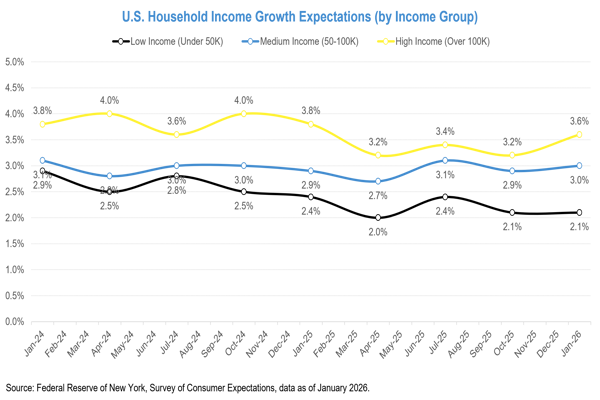
The K-shaped recovery in global incomes has created an uneven consumer base, where higher-income segments continue to see wealth expansion, while lower-income groups remain constrained. This divergence is critical to understanding premium travel demand. Airlines are tapping into a growing pool of consumers with disproportionate spending power.
This macroeconomic backdrop explains why premium demand has remained resilient even amid broader economic uncertainty. It also demonstrates that premium growth is not cyclical in the traditional sense, but based on income polarization, which is likely to persist over the medium term.
Exhibit 2
Premium has become a mainstream purchase
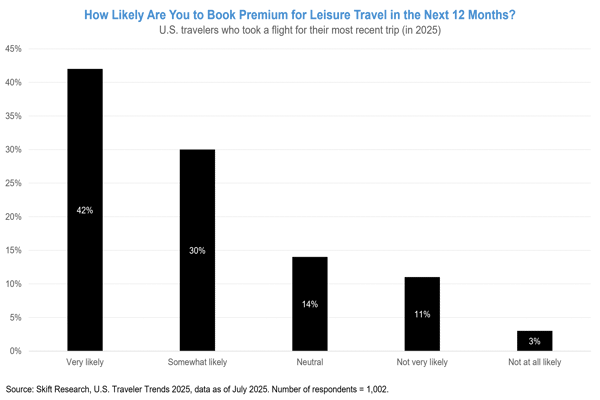
This change in ability to pay is being reinforced by a parallel change in consumer behavior. More than 70% of travelers now say they would book premium cabins for a better experience. Much of that demand comes from self-funded leisure travelers who prioritize comfort, time savings, and overall experience — a group that once sat well outside the premium market. That broad-based willingness to trade up significantly expands the addressable market and gives airlines the confidence to rethink how they allocate capacity.
Exhibit 3
Airlines are reallocating cabin space toward higher-yield travelers
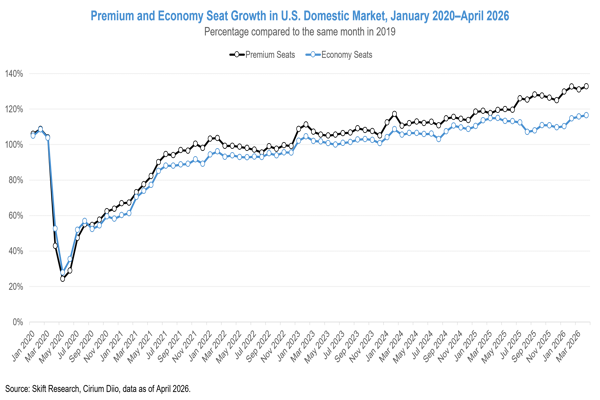
In the U.S. domestic market, premium seat capacity has grown at roughly twice the rate of economy seats since 2020. Airlines are reallocating cabin space toward higher-yield passengers and prioritizing revenue density over sheer passenger numbers — a clear departure from the load-factor optimization that defined the previous era. This is a fundamental change in how airline economics are being managed.
Exhibit 4
Capacity expansion is becoming a competitive race
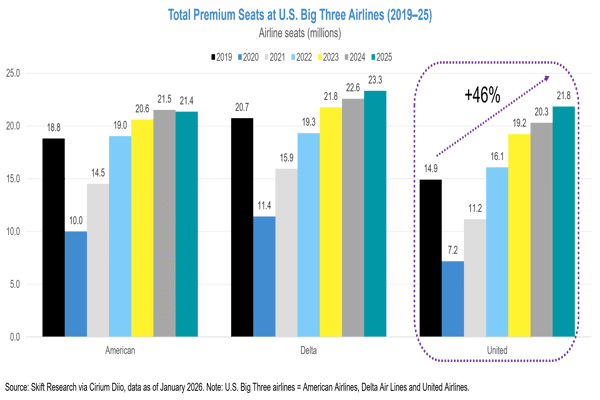
Within this broader supply expansion, competitive dynamics are beginning to take shape. Carriers such as United Airlines have been particularly aggressive, increasing premium seat capacity by nearly 46% since 2019. United’s expansion is a bet on capturing a disproportionate share of high-yield travelers, not simply a read on demand.
This competition for market share might foreshadow a classic airline industry dilemma. If too many airlines scale premium simultaneously, they run the risk of oversupplying the market and creating pricing pressure within this segment.
Exhibit 5
Premium is expanding beyond legacy carriers into low-cost models
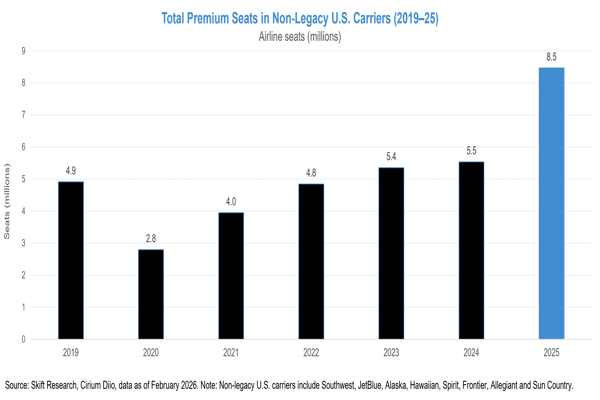
The shift now reaches well beyond full-service carriers. Low-cost airlines have nearly doubled premium capacity since 2019, adding millions of higher-yield seats to the market and turning premium into a standardized, scalable revenue lever across business models. As premium becomes more accessible, it broadens demand and intensifies competition.
Exhibit 6
Demand is keeping pace with premium supply for now
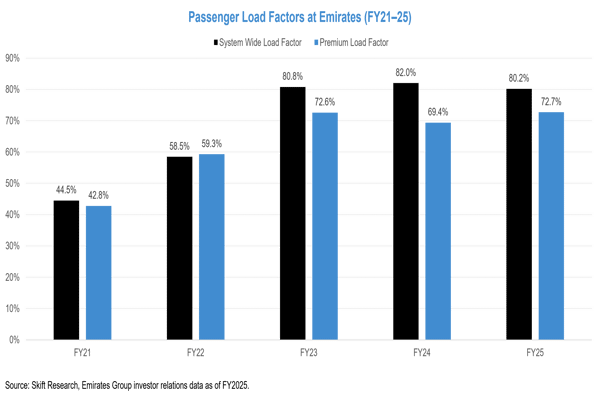
Crucially, demand so far has kept pace with this rapid expansion. Rising premium cabin load factors at airlines such as Emirates, now exceeding 70%, indicate that higher-yield inventory is being consistently absorbed, even in long-haul markets. This is a key validation point for the strategy: airlines are not only adding premium seats, but successfully filling them at strong utilization levels, fueling confidence in continued investment.
Exhibit 7
Premium is driving disproportionate revenue growth
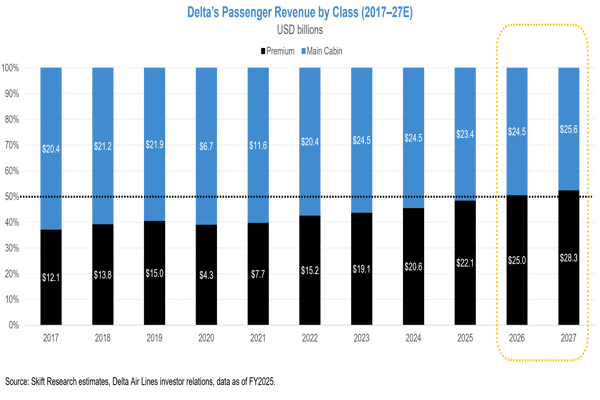
The financial impact of this shift is already evident. Premium revenues at Delta Air Lines have increased by nearly 50% since 2019, significantly outpacing overall revenue growth and driving disproportionate value within airline revenue streams. For many carriers, premium is becoming the primary engine of revenue expansion, helping offset margin pressures elsewhere in the business.
Exhibit 8
The economics of premium are changing airline priorities
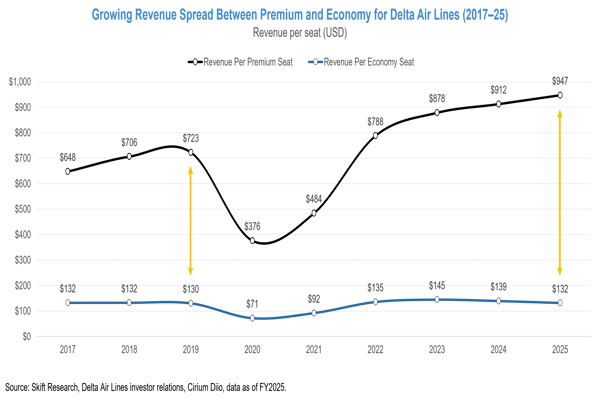
This dynamic is further amplified by the widening gap in unit economics. Revenue per premium seat has surged to multiples of economy, creating a growing spread that changes how airlines think about optimization. Airlines are optimizing for revenue per unit of cabin space, with premium passengers delivering outsized returns relative to their footprint.
Exhibit 9
Premium pricing power is holding across global carriers
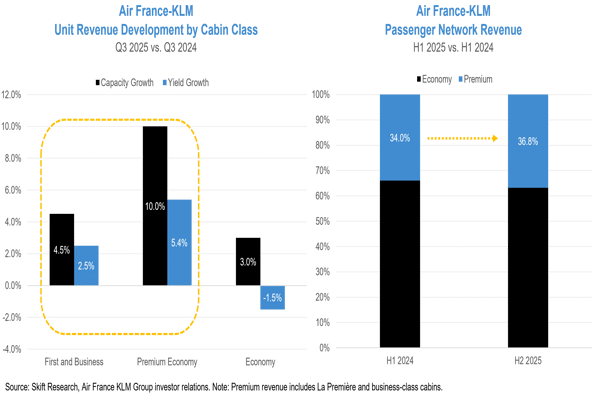
This is not an isolated phenomenon. Airlines such as Air France-KLM are also reporting stronger yield growth in premium cabins. Premium demand is proving to be more resilient and less price-sensitive, allowing airlines to sustain higher margins even in competitive environments.
Exhibit 10
Premium is becoming central to airline revenue models
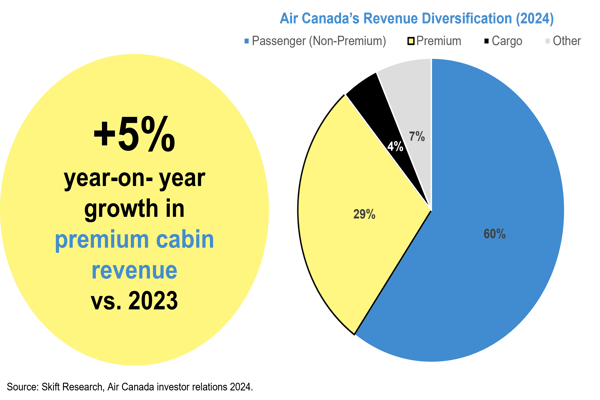
Taken together, these changes are reshaping the core economics of the industry. At carriers like Air Canada, premium cabins now account for nearly 30% of total revenue, demonstrating how central this segment has become. What began as a post-pandemic surge has become a rebalancing of airline business models, with premium now a defining pillar of revenue strategy.
Skift View
05 / 07
Premium travel's remarkable run may be setting up its own correction. As more airlines converge on the same premium-heavy model, the industry may be setting itself up for the next cycle of imbalance. Premium works exceptionally well when demand is strong and supply is constrained. If too many airlines scale premium capacity simultaneously, particularly in long-haul markets, the result could be yield dilution and increased competition for a finite pool of high-value travelers.
There is a paradox here. On the one hand, the risk of oversupply is real. Yet on the other hand, we struggle to find any sign of material weakness in premium demand as it stands today. If anything, the opposite is true: the post-pandemic surge in high-yield demand has evolved into something far more durable, driven by widening gaps in income and a growing willingness among travelers to pay for the comfort and experience. Airlines have responded in kind by reallocating capacity, redesigning revenue management, and building business models around fewer, higher-paying customers. The risk of correction is only worth flagging at all because of how thoroughly premium has already reset airline economics since the pandemic.
From Delta's nearly 50% increase in premium revenues since 2019 to premium seat growth outpacing the economy in the U.S., the signals are consistent: airlines are increasingly generating disproportionate value from a smaller, higher-paying segment of travelers.
At the same time, the demand side is reinforcing this shift. The rise of a K-shaped consumer economy, where higher-income households continue to see income growth while lower-income segments lag, is directly influencing travel behavior. A growing share of premium demand now comes from self-funded leisure travelers who will pay for comfort, time savings, and experience — well beyond the corporate accounts that used to define the cabin. More than 70% of travelers are open to booking premium for a better experience, which shows how broad this willingness to pay has become.
What is most notable, however, is how deeply this trend is reshaping airline strategy. Premium is influencing fleet decisions, network planning, revenue management, and even low-cost carrier models. Airlines are adding more premium seats, but also redesigning their entire commercial architecture around yield optimization. The success of carriers aggressively expanding premium capacity, alongside rising premium load factors in markets like the Middle East, suggests that this strategy is working for now — which is precisely why the convergence risk described above matters. The rewards will go to the carriers who build the most adaptive, segmented, demand-aware premium strategies.
Key takeaways
Premium demand is not cyclical
- Driven by a K-shaped income recovery and expanding high-income traveler base
- Less sensitive to economic volatility than traditional travel segments
The addressable premium market has expanded dramatically
- Over 70% of travelers now show willingness to trade up for better experiences
- Premium demand is increasingly led by leisure travelers, not just corporate travel
Airlines are reallocating capacity toward higher yield
- Premium seat growth is outpacing economy across key markets
- Cabin mix is being redesigned to prioritize revenue density over volume
Premium is becoming a core revenue engine
- Premium revenues are growing faster than overall airline revenues
- In some cases, premium contributes around 30% to total airline revenue
Unit economics strongly favor premium
- Revenue per premium seat is many times higher than economy
- Airlines are shifting focus from load factors to revenue per seat
The next risk is overcapacity, not demand
- Industry-wide expansion into premium could lead to yield dilution
- Long-term success depends on disciplined, demand-led scaling
The PAth Forward
06 / 07
Actions To Take Now
Six concrete moves to make
01
Reconfigure cabin mix toward premium density
Airlines should increase the share of premium seats across both narrowbody and widebody fleets. This should be supported by accelerated retrofit programs, particularly focused on expanding premium economy and business class capacity, where demand is strongest.
02
Redesign revenue management around willingness to pay
This means moving beyond static, cabin-based pricing toward more dynamic segmentation models, while leveraging behavioral and intent-based data instead of relying solely on fare buckets.
03
Expand premium economy as the "mass premium" product
Airlines should treat this as the fastest-growing segment and carefully optimize pricing gaps relative to both economy and business to maximize conversion.
04
Double-down on leisure premium demand
This requires building products tailored to self-funded premium travelers, rather than relying primarily on corporate demand, and actively targeting high-income leisure segments as well as occasion-based travel.
05
Integrate ancillaries into premium strategy
In doing so, the lines between traditional fare classes and upsell pathways should become more fluid, enabling more effective monetization.
06
Align network strategy with premium demand
Airlines should prioritize routes with strong premium origin-and-destination traffic, rather than simply focusing on volume. Airlines should also re-evaluate marginal long-haul routes through a premium lens, ensuring that capacity deployment reflects yield potential and not just passenger numbers.
Decision Horizon
Your roadmap, in order of urgency
3 months
Tighten fare ladders and price gaps: Refine pricing gaps across economy, premium economy, and business to better capture willingness to pay and maximize upsell conversion.
6 months
Reposition premium economy as the core mass premium product: Clarify product differentiation and pricing to position premium economy as the most scalable and accessible premium offering.
1 year
Reconfigure cabin mix toward premium density: Increase premium seat share on select aircraft where demand supports it, prioritizing revenue per square foot over volume.
18 months
Accelerate aircraft retrofits for premium expansion: Invest in retrofits focused on premium economy and business class to align supply with demand trends.
2 years
Commit to premium-optimized fleet strategy: Lock in aircraft configurations and delivery pipelines designed around higher premium seat density.
Long-term risk watch (5–10 years)
Monitor premium demand elasticity: Track how sensitive premium travelers become to pricing and economic cycles, as shifts in willingness to pay could quickly erode yields in an increasingly supply-heavy market.
In The MArketplace
07 / 07
Premium as the New Differentiator: Insights from the Bernstein Conference via Airline Weekly
The 42nd Annual Strategic Decisions Conference at Bernstein offered a striking consensus across U.S. carriers. Premium revenue is now the defining growth lever across the industry, full-service and low-cost alike, and drives revenue quality.
Robert Isom, CEO of American Airlines, was unambiguous about where demand strength is concentrated. Business class remains the single best-performing product in American's portfolio, with premium leisure close behind. Corporate bookings are up 13% year-over-year, and tickets booked through travel management companies yield roughly double a typical leisure fare, demonstrating how the premium and corporate channel disproportionately drives revenue quality, not just volume.
Scott Kirby, CEO of United Airlines, framed premium product and service excellence as a core competitive differentiator, particularly in contested markets such as New York, Los Angeles, and Chicago, where schedule dominance alone is insufficient. Kirby also positioned Starlink Wi-Fi as a premium differentiator aimed squarely at high-value frequent fliers, with United on track to be the first carrier to outfit its entire fleet.
Perhaps the most telling signal of how far the premium wave has traveled came from Bob Jordan, CEO of Southwest Airlines. Jordan all but confirmed that lounges, long-haul routes, and potentially true first-class seating are on the horizon, driven by demand from both business and leisure travelers alike. Southwest's Rapid Rewards loyalty membership is growing at nearly 40% annually, with elite tier growth outpacing even that, suggesting its upmarket transformation is already attracting a meaningfully higher-spending customer base.
Examples and Further Reading
Skift Research reports
- Are premium cabins the future for airlines?
- Europe's airline giants: 2025 chartbook
- The changing face of air travel: What are passengers looking for?
- Global airline sector market estimates 2025
- Airline loyalty: The financial powerhouse at the centre of airline strategy
- Turbulence and tailwinds: Shifting trends in the airline industry